Deligreen Charger Store
EU stock Sodium ion 210Ah LiFePO4 3.0V Prismatic Cell with M6 Studs
EU stock Sodium ion 210Ah LiFePO4 3.0V Prismatic Cell with M6 Studs
Tilgængelighed for afhentning kunne ikke indlæses
Specification:
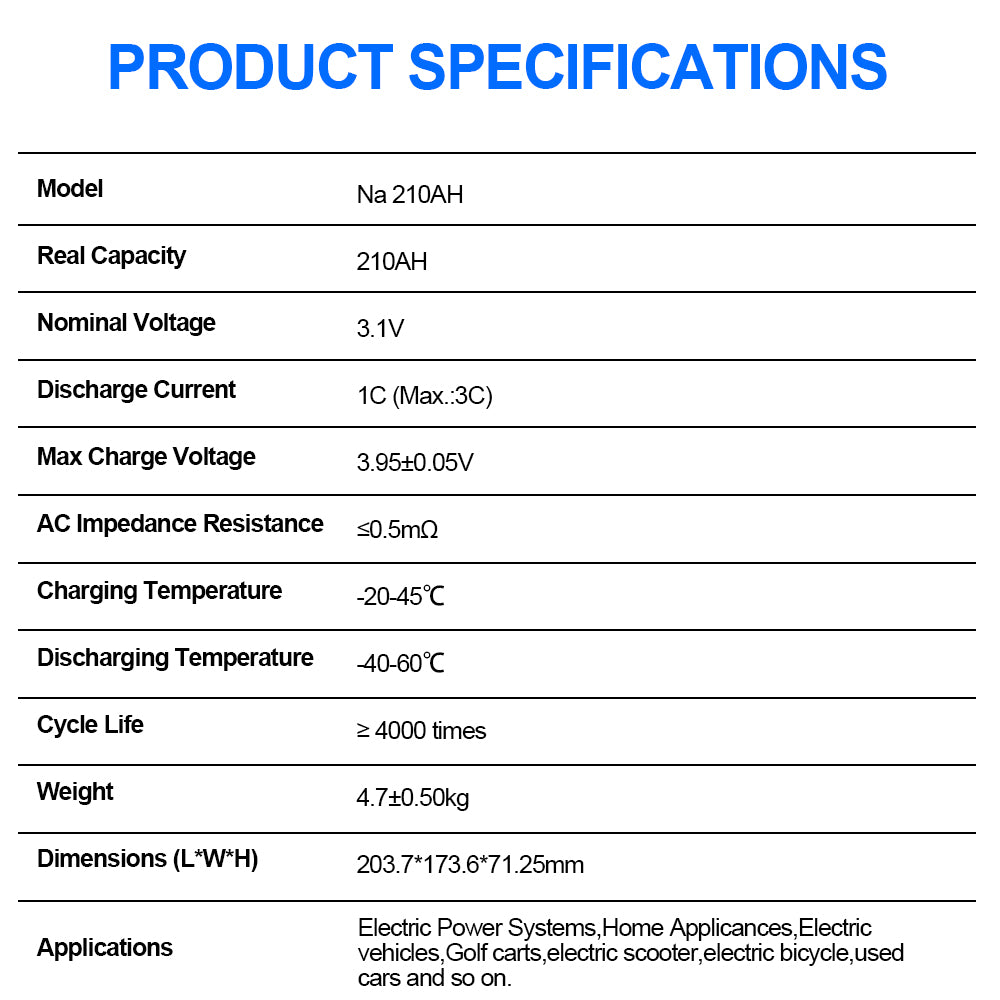
| Battery Type | NaFP71/173/204CY-210 |
| Cell Grade | Brand New Grade A Cell |
| Nominal Capacity | 210Ah |
| Nominal Voltage | 3V |
| Internal Resistance | ≤0.5mΩ |
| Size (Not include the studs) | 203.7mm X 174mm X 71.25mm |
| Weight | 4.7±0.5kg |
| Standard Charge Voltage | 3.95 ±0.05 V |
| Standard Discharge Voltage | 1.50 ±0.05V |
| Standard Charge/Discharge Current | 0.5C |
| Max Charge/Discharge Current | 1C |
| Max Pulse Charge/Discharge (20s) | 3C |
| Charging Temperature | 0℃~45℃ |
| Discharging Temperature | -40℃~60℃ |
| Storage Temperature | -20℃~ 60℃ |
| Storage Temperature | -20℃~ 60℃ |
| Studs | M6/Double hole |
| Warranty | 5Years |
| Warehouse :EU /CN in stock |


Why Choose Sodium-Ion Batteries?
Sodium-ion batteries are emerging as a promising energy storage solution thanks to their excellent low-temperature performance, flexible voltage characteristics, and enhanced safety features. Compared with conventional LiFePO4 batteries, sodium-ion battery technology offers several advantages for residential energy storage and other demanding applications.
1. Wider Discharge Voltage Range
Sodium-ion batteries offer excellent discharge tolerance and can withstand discharge down to 0V under specified conditions without compromising battery quality.
In comparison, LiFePO4 batteries may experience performance degradation or damage if the cell voltage drops below 2.0V.
This feature provides greater flexibility in battery management and helps improve system reliability.
2. Higher Operating Voltage Platform
Sodium-ion batteries feature a higher voltage platform of up to 3.95V, compared with approximately 3.65V for LiFePO4 batteries.
This higher voltage platform offers potential advantages in energy output and system design, making sodium-ion technology an attractive option for advanced energy storage applications.
3. Excellent Low-Temperature Performance
One of the key advantages of sodium-ion batteries is their excellent performance in cold environments.
Sodium-ion electrolytes offer better ionic conductivity at low temperatures, helping maintain higher capacity and discharge performance in cold conditions.
- At -20°C, sodium-ion batteries can retain over 80% of their capacity.
- Under comparable conditions, LiFePO4 batteries typically retain less than 60% of their capacity.
- Sodium-ion batteries support low-temperature charging at -20°C within specified charging limits, while conventional LiFePO4 batteries generally require charging temperatures above 0°C.
This reduces the need for additional battery heating systems in suitable applications and makes sodium-ion batteries particularly attractive for cold-climate energy storage.
Temperature-Dependent Charging Performance
| Ambient Temperature | Maximum Charging Rate |
|---|---|
| -20°C to 0°C | ≤0.20C |
| 0°C to 45°C | ≤0.50C |
Temperature-Dependent Discharging Performance
| Ambient Temperature | Maximum Discharging Rate |
|---|---|
| -40°C to 0°C | ≤0.50C |
| 0°C to 45°C | ≤0.50C |
| 45°C to 60°C | ≤0.20C |
These temperature-dependent limits help ensure reliable battery operation across a wide range of environmental conditions.
4. Enhanced Safety and Chemical Stability
Sodium-ion batteries feature stable electrochemical characteristics, making them a promising choice for safer energy storage solutions.
Their chemical stability, combined with an appropriate battery management system (BMS) and proper system design, helps support reliable operation in residential energy storage applications.
For homeowners and energy storage system integrators, sodium-ion technology offers an attractive alternative for developing dependable home energy storage solutions.
Sodium-Ion Batteries: A New Choice for Energy Storage
With excellent low-temperature performance, a wide operating temperature range, flexible voltage characteristics, and promising safety features, sodium-ion batteries are becoming an attractive alternative to traditional LiFePO4 batteries.
Whether used for home energy storage, solar energy systems, or other stationary energy storage applications, sodium-ion technology offers new possibilities for reliable energy storage in diverse climates.


What's in the Box
4*Sodium 210Ah Battery Cells
4*Flexible Bus Bars/nuts
Well-protected carton box with thick foam,4 units in 1 box.
Free DDP shipping from EU warehouse( 5-7 working days for Delivery)